
Implementing a Rate Limiter: Protecting Your API from Abuse
A deep dive into rate limiting concepts, exploring various algorithms like Token Bucket and Sliding Window, and practical implementation considerations for distributed systems.
Implementing a Rate Limiter: Protecting Your API from Abuse
In the world of web services and APIs, rate limiting is a critical mechanism for ensuring stability, fairness, and security. It controls the number of requests a user or client can make to a server within a given time window. Without effective rate limiting, an API can be vulnerable to various forms of abuse, from accidental overload due to misconfigured clients to malicious Denial-of-Service (DoS) attacks. This can lead to degraded performance, increased operational costs, and even complete service outages.
This blog post will delve into the core concepts of rate limiting, explore various algorithms used to implement it, examine real-world examples, and discuss practical considerations for building robust rate limiters in distributed systems.
Understanding Rate Limiting Algorithms
Several algorithms exist for implementing rate limiters, each with its own trade-offs in terms of accuracy, resource usage, and burst handling. Let's explore the most common ones.
1. Fixed Window Counter
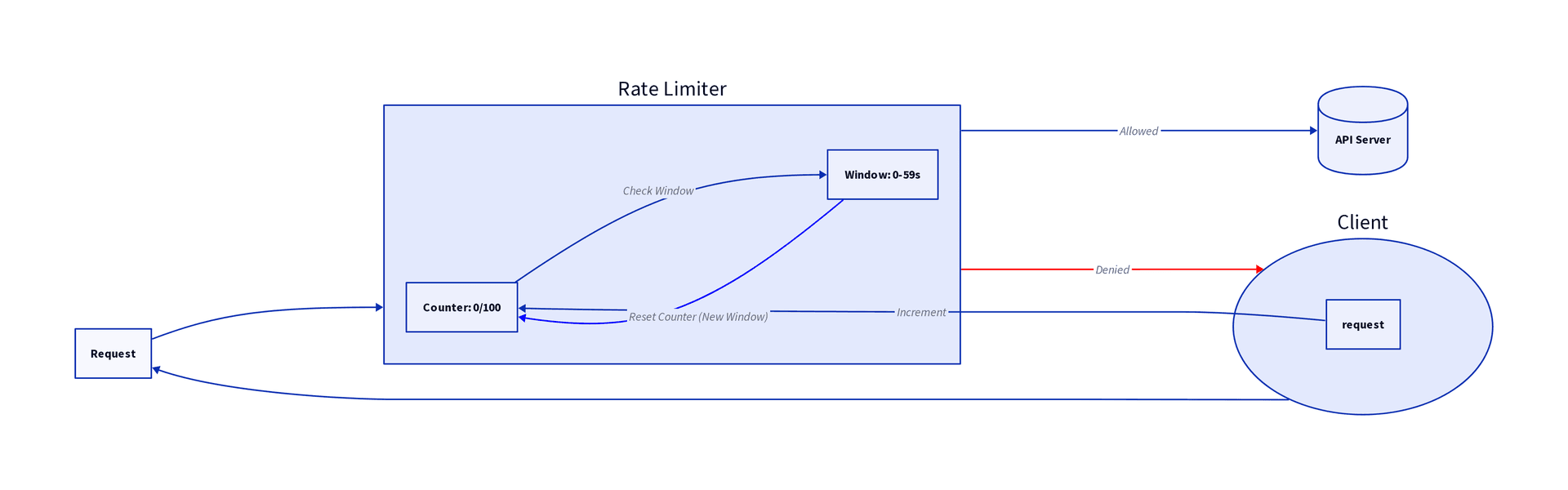
The Fixed Window Counter is the simplest rate limiting algorithm. It divides time into fixed-size windows (e.g., 60 seconds). Each window has a counter, and every request increments this counter. If the counter exceeds a predefined limit within the current window, subsequent requests are denied until the next window begins. When a new window starts, the counter is reset to zero.
How it Works:
- Define a fixed time window (e.g., 1 minute).
- For each client, maintain a counter for the current window.
- When a request arrives, check if the current time falls within the active window.
- If it does, increment the counter. If the counter is below the limit, the request is allowed. Otherwise, it's denied.
- If the request arrives in a new window, reset the counter and allow the request.
Advantages:
- Simplicity: Easy to understand and implement.
- Low Memory Usage: Requires minimal storage per client (just a counter and a timestamp).
Disadvantages:
- Burstiness at Window Edges: A major drawback is that it can allow up to twice the rate limit at the boundaries of windows. For example, if the limit is 100 requests per minute, a client could make 100 requests in the last second of one window and another 100 requests in the first second of the next window, effectively making 200 requests in a very short period [1].
2. Sliding Window Log
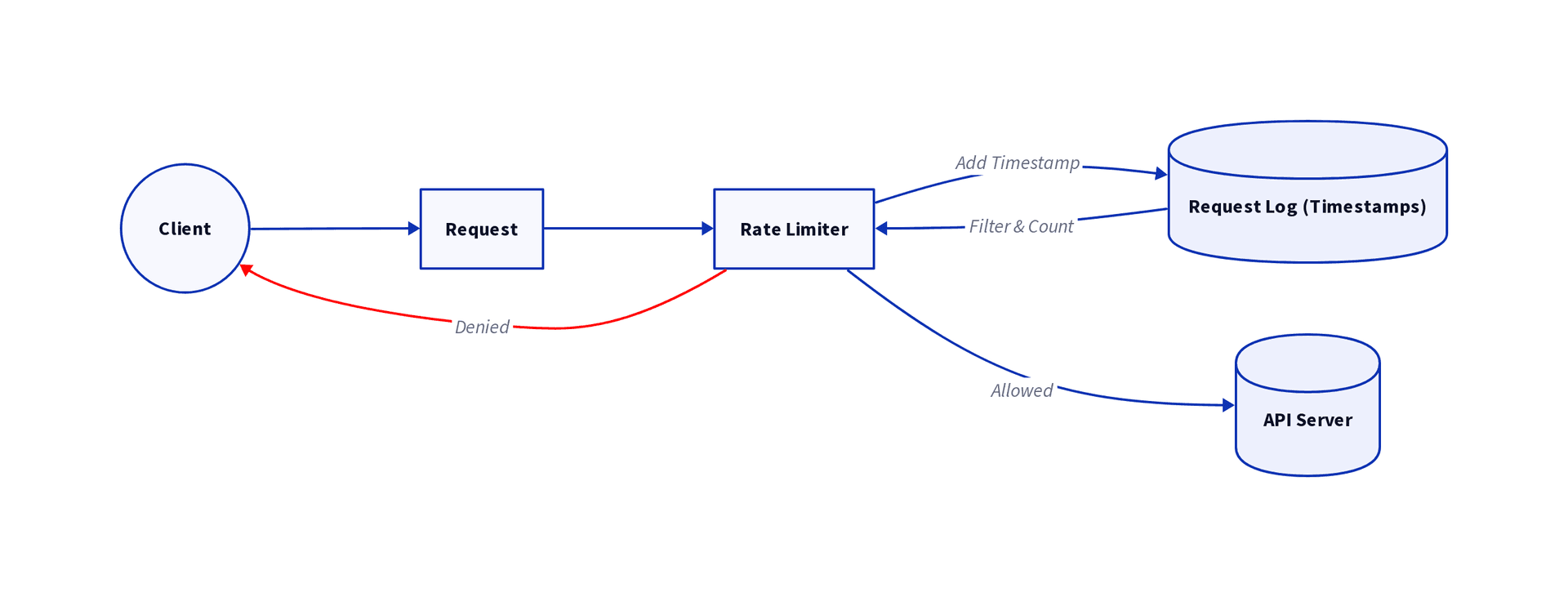
The Sliding Window Log algorithm offers a more accurate approach to rate limiting by keeping a timestamped log of every request made by a client. When a new request arrives, the system removes all timestamps older than the current window and then counts the remaining requests.
How it Works:
- For each client, maintain a sorted list (log) of request timestamps.
- When a request arrives, get the current timestamp.
- Remove all timestamps from the log that are older than
current_timestamp - window_size. - Add the
current_timestampto the log. - If the number of timestamps in the log is greater than the allowed limit, deny the request. Otherwise, allow it.
Advantages:
- High Accuracy: Provides the most accurate rate limiting as it considers the exact timing of each request.
- No Burstiness at Boundaries: Eliminates the edge-case problem of the Fixed Window Counter.
Disadvantages:
- High Memory Usage: Can consume significant memory, as it stores a timestamp for every request within the window [1].
3. Sliding Window Counter
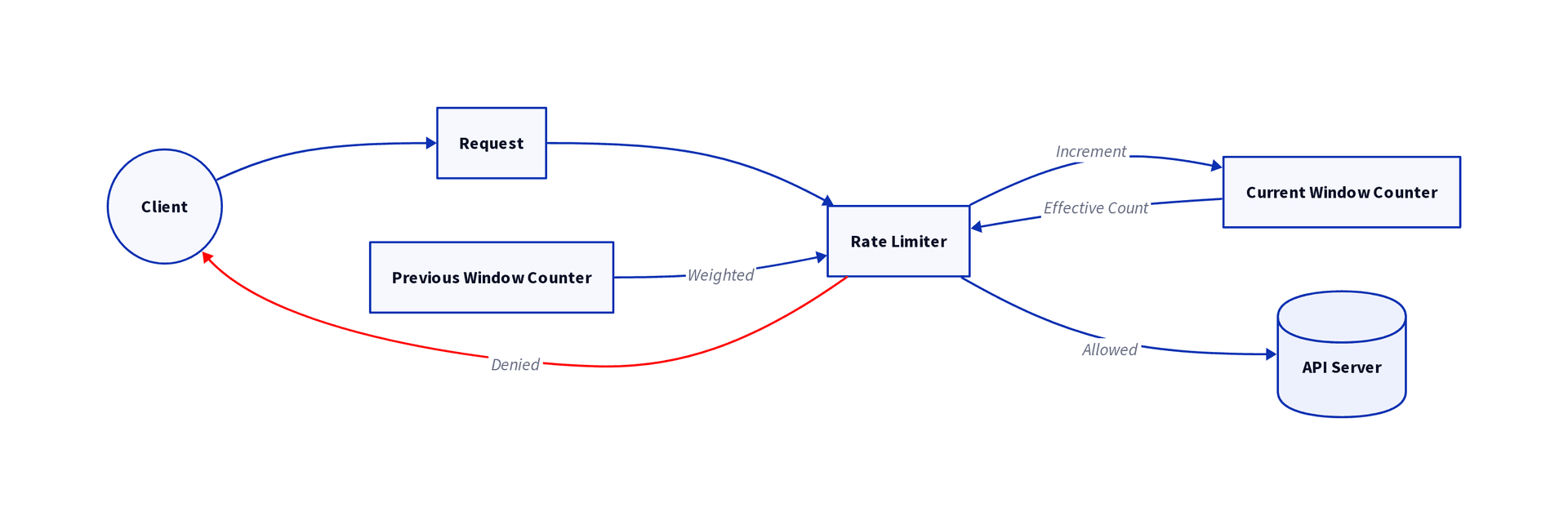
The Sliding Window Counter algorithm is a hybrid approach that aims to mitigate the burstiness issue of the Fixed Window Counter while being more memory-efficient than the Sliding Window Log. It works by combining the current window's count with a weighted count from the previous window.
How it Works:
- Divide time into fixed-size windows.
- For each client, maintain a counter for the current window and the previous window.
- When a request arrives, calculate the
effective_countfor the current sliding window.effective_count = (requests_in_previous_window * overlap_percentage) + requests_in_current_window
- If
effective_countexceeds the limit, deny the request. Otherwise, allow it and increment the current window's counter.
Advantages:
- Reduced Burstiness: Significantly reduces the edge-case problem compared to the Fixed Window Counter.
- Memory Efficient: Requires only two counters per client [1].
4. Token Bucket
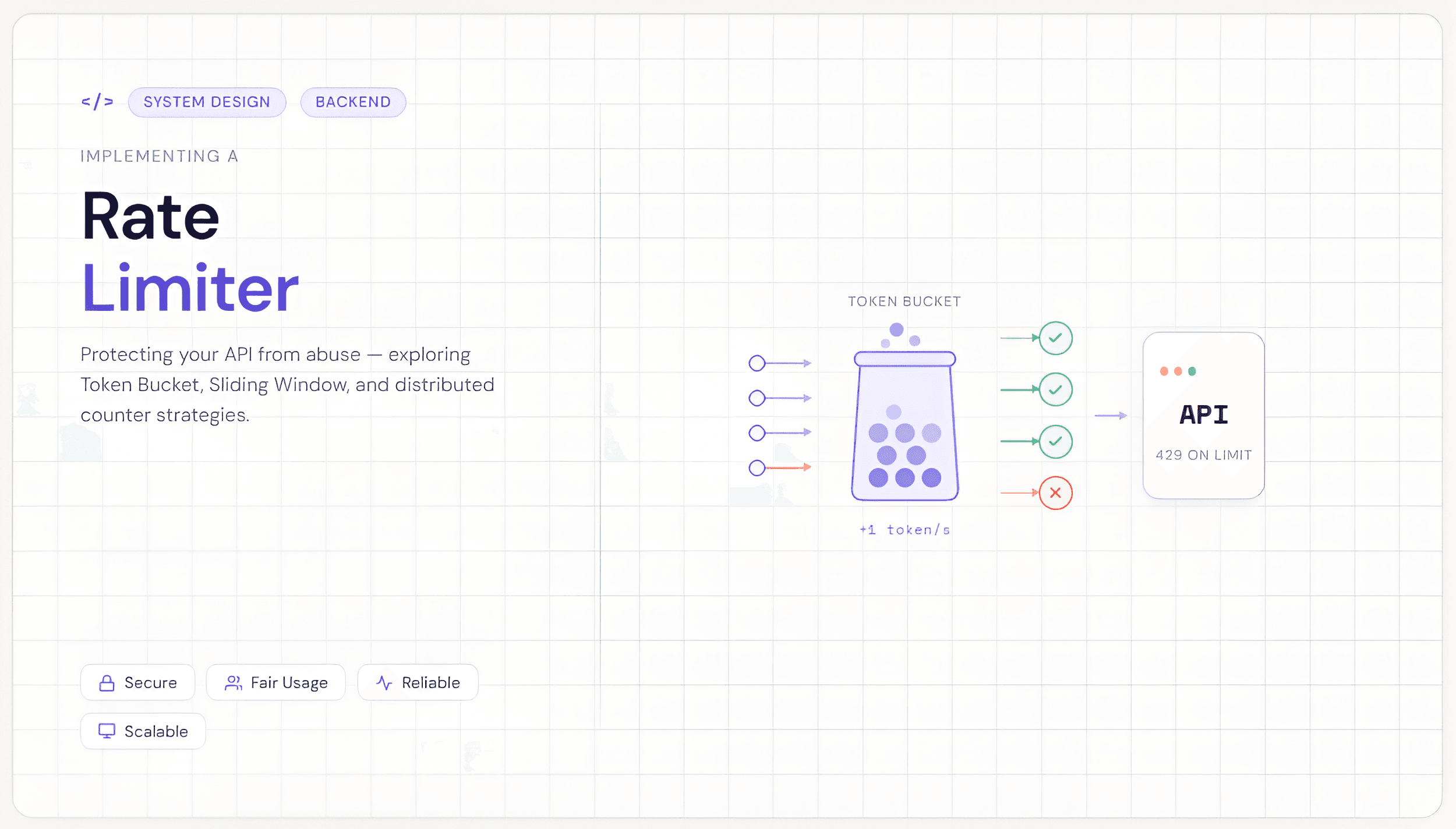
The Token Bucket algorithm is a popular choice because it allows for controlled bursts of requests. Imagine a bucket that holds a fixed number of tokens. Tokens are added to the bucket at a constant rate. Each incoming request consumes one token.
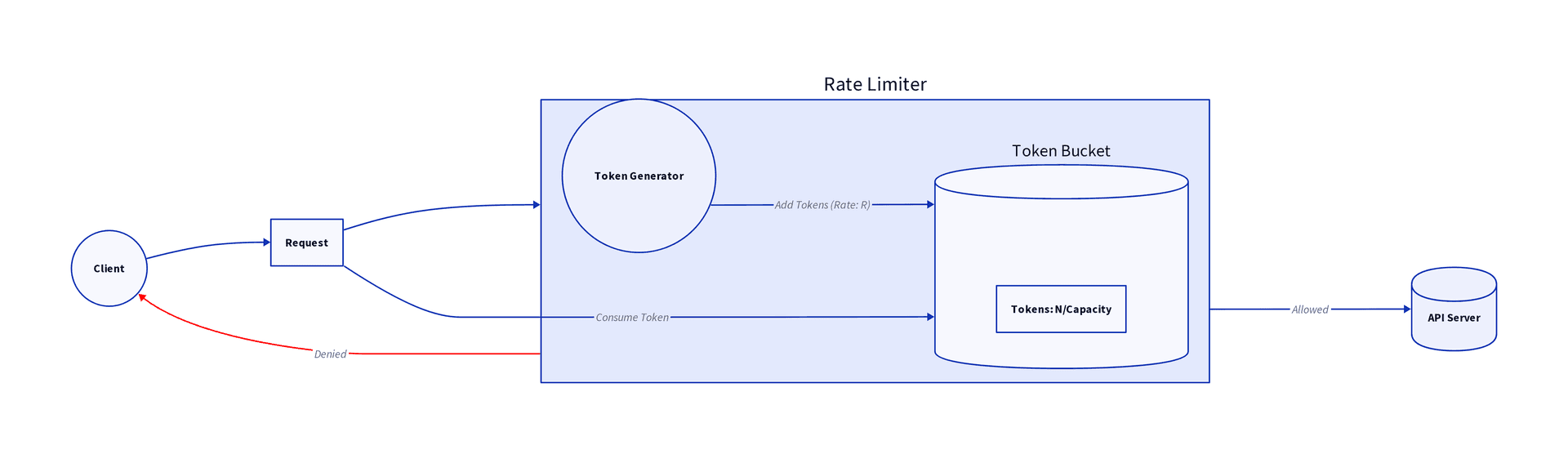
How it Works:
- A bucket of a fixed capacity is maintained for each client.
- Tokens are added to the bucket at a constant rate (e.g., 1 token per second).
- When a request arrives, it tries to fetch a token from the bucket.
- If a token is available, it's consumed, and the request is allowed.
- If no tokens are available, the request is denied or buffered.
Advantages:
- Allows Bursts: Can handle short bursts of traffic up to the bucket's capacity.
- Smooths Traffic: Over time, the average rate is limited by the token generation rate [1].
5. Leaky Bucket
The Leaky Bucket algorithm works by adding requests to a queue (the bucket) and processing them at a constant rate (the leak rate). If the queue is full, incoming requests are dropped.

How it Works:
- A queue (bucket) of a fixed capacity is maintained for each client.
- Incoming requests are added to the queue.
- Requests are processed (leak out) from the queue at a constant rate.
- If the queue is full, new incoming requests are dropped.
Advantages:
- Smooths Traffic: Produces a steady outflow of requests, effectively smoothing out bursts.
- Prevents Overload: Guarantees that the processing rate never exceeds a certain threshold [1].
Real-World Examples of Rate Limiting
Rate limiting is ubiquitous in modern web services. Here are a few prominent examples:
- GitHub API: GitHub employs rate limiting to ensure fair usage. Authenticated users typically have a limit of 5,000 requests per hour, while unauthenticated requests are limited to 60 per hour. They communicate status through HTTP headers like
x-ratelimit-limit,x-ratelimit-remaining, andx-ratelimit-reset[2]. - Twitter API: Twitter uses rate limiting to manage load, with different endpoints having different limits. Exceeding them results in a
429 Too Many Requestsstatus code. - Stripe API: Stripe implements rate limiting to protect its infrastructure and ensure stability, preventing malicious actors from overwhelming their systems with fraudulent requests.
Implementation Considerations
Implementing a robust rate limiter, especially in a distributed system, involves several key considerations:
- Distributed Counters: In a microservices architecture, centralized storage (like Redis) is crucial for maintaining accurate global counters across all instances [1].
- Atomicity: Operations must be atomic to prevent race conditions. Redis Lua scripting is an excellent way to achieve this [1].
- Client Identification: Clients can be identified by IP address, API key, or user ID, depending on security and UX goals.
- Graceful Degradation: Consider queuing requests or returning cached data instead of simply denying requests during peak load.
- HTTP Headers: Always communicate rate limit status to clients using standard headers (
X-RateLimit-Limit,X-RateLimit-Remaining,X-RateLimit-Reset,Retry-After) [2].
Conclusion
Rate limiting is an indispensable component of any resilient and scalable API. By understanding the various algorithms—from the simple Fixed Window Counter to the more sophisticated Token and Leaky Buckets—developers can choose the most appropriate strategy for their specific needs. Proper implementation ensures a stable, fair, and high-performing service for all users.